DTEAssurance
DTEAssurance is an R package for implementing assurance methodology in the design of clinical trials with an anticipated delayed treatment effect (DTE).
It uses elicited prior distributions—via the SHELF framework—for the delay duration and post-delay hazard ratio, and simulates operating characteristics to inform trial design.
The methodology is based on the following papers:
Salsbury JA, Oakley JE, Julious SA, Hampson LV.
Assurance methods for designing a clinical trial with a delayed treatment effect.
Statistics in Medicine, 2024; 43(19): 3595–3612. doi:10.1002/sim.10136Salsbury JA, Oakley JE, Julious SA, Hampson LV.
Adaptive clinical trial design with delayed treatment effects using elicited prior distributions.
arXiv preprint, 2025; arXiv:2509.07602 [under revision at Pharmaceutical Statistics]
Assurance Methods for Delayed Treatment Effects
Shiny App
Launch the interactive app to explore assurance under delayed treatment effects:
DTEAssurance::assurance_shiny_app()Offline Example
You can also use the package offline via the main function:
DTEAssurance::calc_dte_assurance()This function requires the following arguments:
-
n_c: Number of patients in the control group -
n_t: Number of patients in the treatment group -
control_model: A named list specifying the control arm survival distribution -
effect_model: A named list specifying beliefs about the treatment effect -
censoring_model: A named list specifying the censoring mechanism -
recruitment_model: A named list specifying the recruitment process -
analysis_model: A named list specifying the statistical test and decision rule -
n_sims: Number of simulations to run
An example of this is shown:
control_model <- list(dist = "Exponential", parameter_mode = "Fixed", fixed_type = "Parameters", lambda = 0.1)
effect_model <- list(delay_SHELF = SHELF::fitdist(c(3, 4, 5), probs = c(0.25, 0.5, 0.75), lower = 0, upper = 10),
delay_dist = "gamma",
HR_SHELF = SHELF::fitdist(c(0.55, 0.6, 0.7), probs = c(0.25, 0.5, 0.75), lower = 0, upper = 1.5),
HR_dist = "gamma",
P_S = 1, P_DTE = 0)
censoring_model <- list(method = "Time", time = 12)
recruitment_model <- list(method = "power", period = 12, power = 1)
analysis_model <- list(method = "LRT", alpha = 0.025, alternative_hypothesis = "one.sided")
result <- calc_dte_assurance(n_c = 300, n_t = 300,
                             control_model = control_model,
                             effect_model = effect_model,
                             censoring_model = censoring_model,
                             recruitment_model = recruitment_model,
                             analysis_model = analysis_model,
                             n_sims = 100)

str(result)
#> List of 4
#>  $ assurance  : num 0.8
#>  $ CI         : num [1, 1:2] 0.708 0.873
#>  $ duration   : num 12
#>  $ sample_size: num 600
We can vary the sample sizes and plot the resulting output:
result <- calc_dte_assurance(n_c = seq(50, 500, by = 50),
                             n_t = seq(50, 500, by = 50),
                             control_model = control_model,
                             effect_model = effect_model,
                             censoring_model = censoring_model,
                             recruitment_model = recruitment_model,
                             analysis_model = analysis_model,
                             n_sims = 500)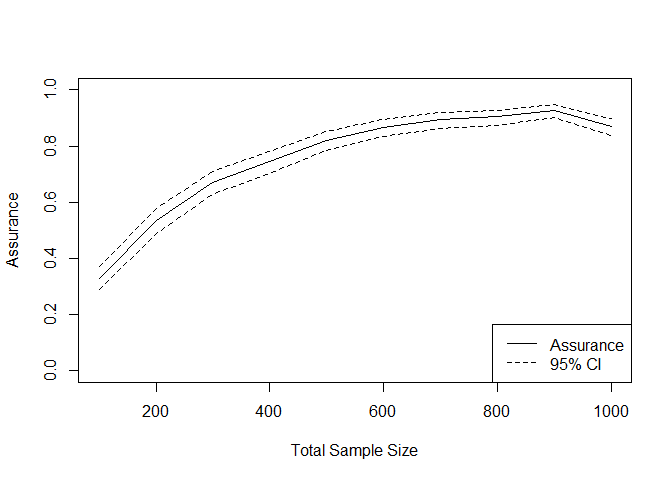
Assurance for DTE - With Group Sequential Designs
Shiny App
Launch the interactive shiny app to explore assurance under delayed treatment effects using group sequential designs:
DTEAssurance::assurance_GSD_shiny_app()Offline Example
You can also use the package offline via the main function:
DTEAssurance::calc_dte_assurance_adaptive()This function requires the following arguments:
-
n_c: Number of patients in the control group -
n_t: Number of patients in the treatment group -
control_model: A named list specifying the control arm survival distribution -
effect_model: A named list specifying beliefs about the treatment effect -
recruitment_model: A named list specifying the recruitment process -
GSD_model: A named list specifying the group sequential design -
n_sims: Number of simulations to run
An example of this is shown:
control_model <- list(dist = "Exponential", parameter_mode = "Fixed", fixed_type = "Parameters", lambda = 0.08)
effect_model <- list(delay_SHELF = SHELF::fitdist(c(3, 4, 5), probs = c(0.25, 0.5, 0.75), lower = 0, upper = 10),
delay_dist = "gamma",
HR_SHELF = SHELF::fitdist(c(0.55, 0.6, 0.7), probs = c(0.25, 0.5, 0.75), lower = 0, upper = 1.5),
HR_dist = "gamma",
P_S = 0.9, P_DTE = 0.7)
recruitment_model <- list(method = "power", period = 12, power = 1)
GSD_model <- list(events = 450,
                  alpha_spending = c(0.0125, 0.025),
                  alpha_IF = c(0.75, 1),
                  futility_type = "none")
result <- calc_dte_assurance_adaptive(n_c = 300, n_t = 300,
                             control_model = control_model,
                             effect_model = effect_model,
                             recruitment_model = recruitment_model,
                             GSD_model = GSD_model,
                             n_sims = 500)

str(result)
#> 'data.frame':    500 obs. of  6 variables:
#>  $ Trial     : int  1 2 3 4 5 6 7 8 9 10 ...
#>  $ Decision  : chr  "Stop for efficacy" "Stop for efficacy" "Unsuccessful at final" "Stop for efficacy" ...
#>  $ StopTime  : num  19.8 20.1 27.3 21.4 20.7 ...
#>  $ SampleSize: int  600 600 600 600 600 600 600 600 600 600 ...
#>  $ Success   : logi  TRUE TRUE FALSE TRUE TRUE FALSE ...
#>  $ Converged : logi  NA NA NA NA NA NA ...
design_summary <- result %>%
        summarise(
          Assurance = mean(Decision %in% c("Stop for efficacy", "Successful at final")),
          `Pr(Early Fut.)` = mean(Decision %in% c("Stop for futility")),
          `Pr(Early Eff.)` = mean(Decision %in% c("Stop for efficacy")),
          `Average Duration` = round(mean(StopTime, na.rm = TRUE), 2),
          `Average Sample Size` = round(mean(SampleSize, na.rm = TRUE), 2)
        )


design_summary
#>   Assurance Pr(Early Fut.) Pr(Early Eff.) Average Duration Average Sample Size
#> 1       0.7              0          0.516            22.47                 600
Notation
The package identifiers map onto the notation of the adaptive-design manuscript (Salsbury et al., doi:10.48550/arXiv.2509.07602) as follows.
| Manuscript | Package |
|---|---|
| PP, (predictive probability) |
PP_val, PP_func()
|
| (futility threshold) |
kappa, GSD_model$kappa, kappa_grid, kappa_star
|
select_kappa_star() |
|
| , (Weibull rate, shape) |
lambda_c, gamma_c
|
post_delay_HR (truth), HR (posterior column) |
|
| (delay) | delay_time |
| (latent state) |
Z, P_Z1, P_Z2, P_Z3
|
| , |
P_S, P_DTE
|
| (posterior-predictive draws) | PP_sims |
| retained MCMC draws |
update_priors_sims (per chain; total = n.chains x this) |
| IF (information fraction) |
futility_IF, alpha_IF
|
| D1, …, D5 | built post hoc from run_paired_scenario() output (see below) |
Designs D1-D5 from paired replicates
run_paired_scenario() is the single entry point for the simulation tables in the manuscript. It simulates each trial once, computes the PP at the futility look once, and records the test statistics at the interim (Z_int_*), the efficacy look (Z_eff_*) and the final analysis (Z_fin_*) without stopping the trial. Every design is then a summary of the same replicates. With c_eff and c_fin the critical values of the group-sequential design at the efficacy look and the final analysis:
-
D1 (fixed design): success if
Z_fin_LRTexceeds the final-only critical value. -
D2 (efficacy look only): success if
Z_eff_LRT > c_eff, otherwiseZ_fin_LRT > c_fin. This iscontinuation_success. -
D3 (D2 plus PP futility): stop for futility if
PP_val < kappa;summarize_grid_by_kappa()evaluates a grid of kappa andselect_kappa_star()picks kappa*. -
D4, D5 (D2 plus Z futility): stop for futility if an interim statistic (
Z_int_LRTorZ_int_MW_t*) is below a cutoff.
apply_design_rule(raw, rule) returns the decision, success, early stopping, sample size and duration of each replicate under one of these rules, using the critical values from make_gsd_design().
Computing environment
The manuscript simulations were run on an HPC cluster with the module rjags/4-13-foss-2022a-R-4.2.1. The settings element returned by the simulation functions records the package, R, rjags and JAGS versions, the git commit, the hostname and a timestamp for each run.
The PP futility rule is selected with GSD_model$futility_type = "PP" and GSD_model$kappa. The names BPP_func(), calibrate_BPP_threshold(), calibrate_BPP_timing(), summarize_grid_by_lambda(), select_lambda_star(), futility_type = "BPP" and GSD_model$BPP_threshold are deprecated and will be removed in the next release.